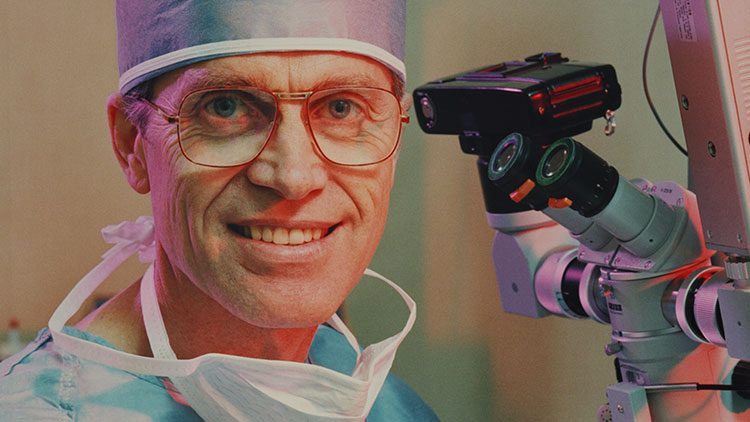

Howard W. Gimbel is one of the world’s most influential ophthalmologists and a professor. He is best known for inventing the continuous curvilinear capsulorhexis technique used in cataract surgery, as reported by icalgary.
From Physicist to Ophthalmologist
Gimbel was born in Calgary and grew up with his siblings on a grain and dairy farm near the village of Beiseker, Alberta. In 1952, he graduated from high school at Canadian University College near Lacombe, Alberta.
After finishing high school, he enrolled at Walla Walla University in Washington, where he majored in physics. During his studies, Howard met the love of his life, Judy Carl, and married her on the day of his graduation.
He later pursued medical studies at Loma Linda University in California, earning his degree in 1960. With a strong foundation in physics and a deep interest in optics, he chose to specialize in ophthalmology. After completing his residency at White Memorial Medical Center in Los Angeles, he returned to Calgary to begin his medical practice as an ophthalmologist.
In January 1974, Gimbel took a course on phacoemulsification, a surgical technique for removing cataracts through a 3-millimeter incision without sutures. Previously, cataract surgery required an incision of 10 to 12 mm, which would then be stitched, often resulting in astigmatism (a condition where light rays do not focus on a single point, creating a blurred and distorted image).
Later that same year, he attended a course on intraocular lens implantation in the Netherlands. While this procedure is now the standard for cataract treatment, it was controversial at the time. Gimbel was one of the first ophthalmologists in North America to successfully adopt and use these lenses in his practice.
Medical Achievements
Howard Gimbel gained recognition for co-developing the continuous curvilinear capsulorhexis technique alongside ophthalmologist Thomas Neuhann. This technique involves creating a precise circular opening on the anterior surface of the lens capsule, enabling smoother phacoemulsification and cataract removal. Gimbel first used this technique in 1983.
In 1984, Gimbel became the first in Canada to introduce radial keratotomy, a procedure for correcting refractive errors in vision. He also acquired an excimer laser for refractive surgery, a technology that was not yet available in Canada at the time.

Gimbel was also the first surgeon in North America to offer implantable collamer lenses, used for correcting moderate to severe refractive errors.
He went on to establish the Gimbel Eye Centre, which specializes in cataract and refractive surgeries. Around the same time, he refined the continuous curvilinear capsulorhexis technique and developed the “divide and conquer nucleofractis” method. This innovative approach divides the cataract into four quadrants, which are then removed using phacoemulsification. Gimbel introduced this safer method of cataract removal in 1991.
Academic Contributions
In February 2000, Gimbel was appointed Chair and Professor of Ophthalmology at Loma Linda University. He also taught ophthalmology at the University of Calgary.
In addition to his academic roles, Gimbel frequently presented his successful surgical techniques at universities and conferences worldwide. He also created instructional videos showcasing his methods. For his remarkable contributions to the field of ophthalmology, Gimbel was honored with the Canadian Ophthalmological Society’s Award of Excellence.