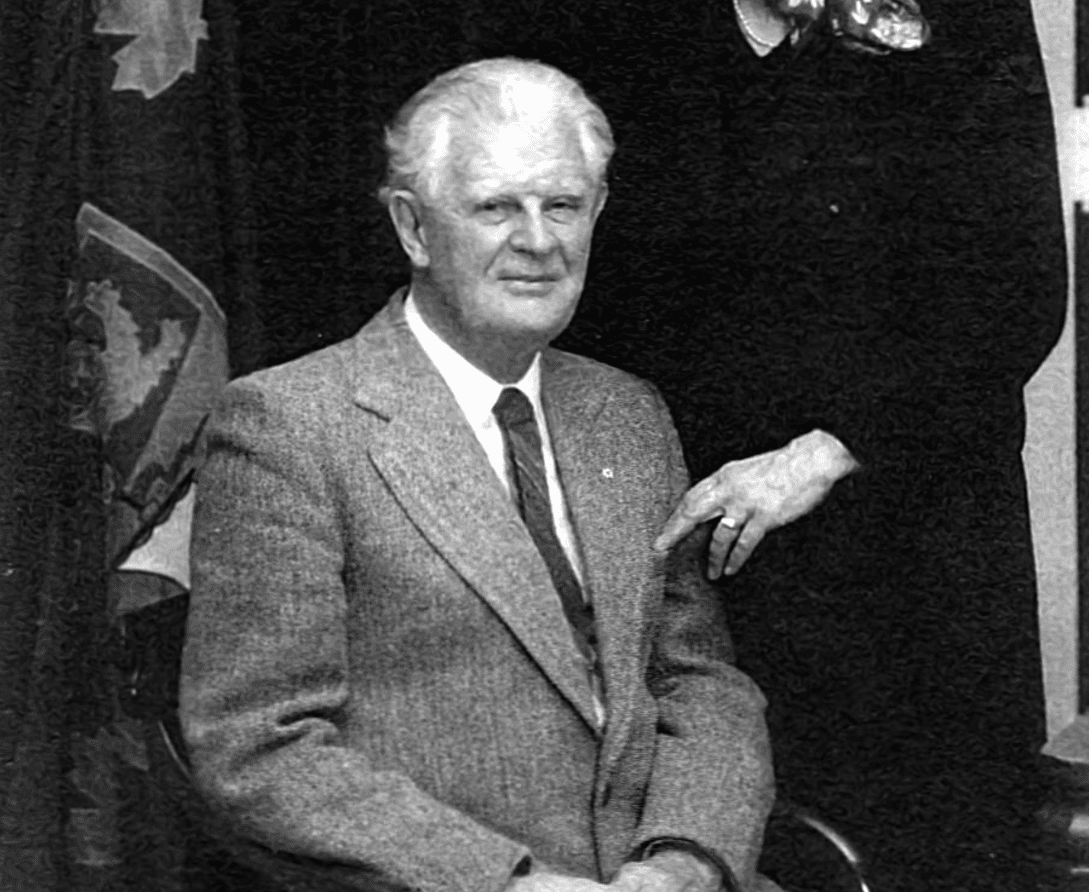

In 1964, George Stanley, a civil servant, historian, soldier, writer, and educator, created the design for Canada’s national flag. Learn more about his life and contributions below on iCalgary.
Early Life and Education
George Stanley was born in Calgary in July 1907. He earned his Bachelor’s degree from the University of Alberta in Edmonton before continuing his studies at Keble College, Oxford University. At Oxford, he achieved his Bachelor’s, Master’s, and PhD degrees.
During his time at Oxford, Stanley was active in sports, playing hockey for the university team. He also authored the book The Birth of Western Canada: A History of the Riel Rebellions and began working on the biography of Louis Riel, a Canadian politician and founder of Manitoba.
Academic Career and Military Service
In 1936, Stanley returned to Canada and started teaching history at Mount Allison University in New Brunswick. Later, he joined the army, serving as an infantry training officer in Fredericton. By 1939, he was stationed in London, working in the Canadian Army Historical Section.
Stanley then took up a teaching position at the University of British Columbia, where he focused on Canadian history. In 1949, he joined the Royal Military College (RMC) in Kingston, where he became head of the history department and served as Dean of Arts for seven years.
At RMC, Stanley introduced Canada’s first-ever course on military history and wrote a textbook on Canadian wars for his students. His former pupils included notable figures like diplomat John de Chastelain and historians Jack Granatstein and Desmond Morton.
Ken Armstrong, one of Stanley’s students, described him as a mentor who encouraged individual achievements, preparing students to think critically rather than simply absorb information.
Other Achievements
George Stanley was actively involved in various organizations. In Kingston, he served as president of the historical society, edited Historic Kingston, and worked on committees to preserve the city’s limestone buildings.
He held leadership roles in several associations, including the Canadian Historical Association, where his 1955 keynote speech, “Act or Pact?…,” became a staple in Canadian university curricula.
Stanley was appointed an Officer of the Order of Canada in 1976 and later elevated to Companion in 1995. From 1981 to 1987, he served as the 25th Lieutenant Governor of New Brunswick. During this time, he also oversaw the publication of The Collected Writings of Louis Riel in 1985, a project involving five Canadian scholars.
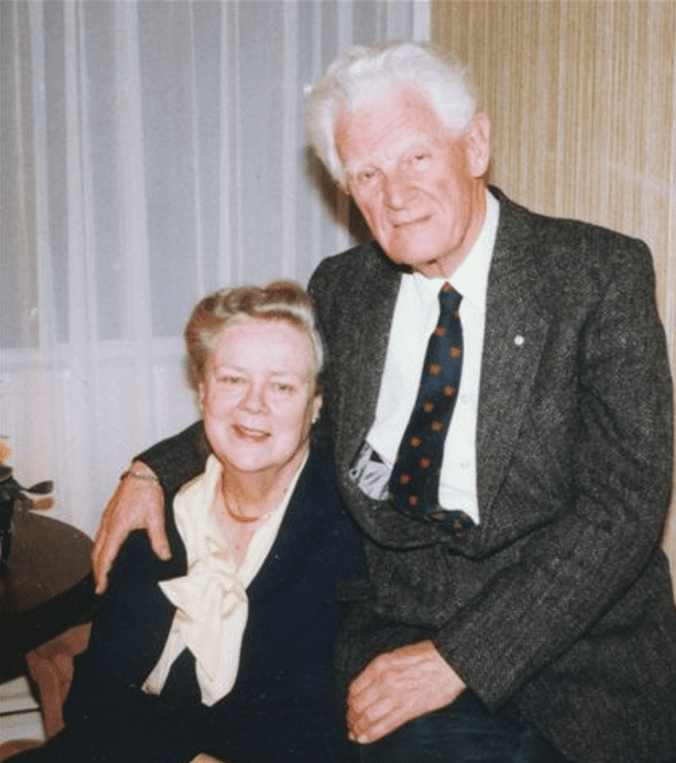
In 1994, the Kingston Historical Society honored Stanley for his contributions to historical research and architectural preservation. At 90, he continued to write, read extensively, give interviews, and inspire young scholars.
Designing the Canadian Flag
In early 1964, George Stanley befriended Canadian politician John Matheson in Kingston. Their children attended Scottish dancing classes together, and Matheson was a member of the committee tasked with approving a new flag design.

While walking through the RMC grounds one day, Stanley pointed to the college’s red-white-red flag and suggested it as the basis for Canada’s new national flag. He proposed replacing the RMC emblem with a red maple leaf in the center, emphasizing that the design would inspire sacrifice, loyalty, and devotion.
Stanley formalized his idea in a four-page memorandum to Matheson on March 23, 1964, attaching a rough sketch of his design. He argued that the new flag should avoid divisive national symbols, advocating for a unified representation.

On October 22, 1964, the Parliamentary Flag Committee selected Stanley’s design, sending it to Parliament for approval. While some modifications were made, including reducing the maple leaf’s points from 13 to 11 by graphic artist Jacques St. Cyr, the design became Canada’s official flag.
The flag was first raised on Parliament Hill on February 15, 1965, amid mixed public reactions. Some Canadians, especially English speakers, were initially divided over the design. Stanley even received a death threat before the ceremony but attended wearing a bright coat, standing out among the crowd.
Legacy
Though debates persisted about whether credit should go to Stanley or St. Cyr, the issue was resolved in 1995 when the Prime Minister officially recognized Stanley as the flag’s designer.
George Stanley passed away in 2002 at the age of 95. He was buried with full military honors in Sackville, New Brunswick. His enduring contributions to Canada’s heritage, especially as the designer of the national flag, remain a testament to his exceptional intellect and vision.