

In 1987, Calgary-based businessman David Martin and MBA graduate Nancy Knowlton founded SMART Technologies. By 1991, the couple had developed the interactive whiteboard in their apartment kitchen, aiming to improve presentations and classroom teaching. In 1992, Intel Corporation became a minority investor, recognizing the potential of their innovation.
The SMART Board has since become a global tool used across industries, replacing traditional flip charts and blackboards in many places. David and Nancy’s invention has improved lives worldwide and earned them numerous awards for their groundbreaking contribution, as highlighted by icalgary.
How the Whiteboard Works
An interactive whiteboard is a touch-sensitive screen connected to a computer. A projector displays the computer’s content onto the board. The system consists of the whiteboard, a projector, and software. Users can interact with computer programs, open files, browse the internet, and write notes directly on the board.
The technology employs a resistive touch system, which registers movements from fingers or a stylus when they make contact with the board’s surface. A thin resistive film layer sits on top of a sturdy board. When touched, the film makes contact with the board, transmitting analog signals to the computer.
The whiteboard can connect to a computer either wirelessly or via cables. Wireless connectivity, such as Wi-Fi or Bluetooth, is particularly suitable for large spaces, eliminating hazards posed by tangled cords.
A unique mounting system eliminates the need for separate projector setups on stands or ceilings. This feature reduces shadows and glare, enhancing visibility on the board.
Impact on the Education System
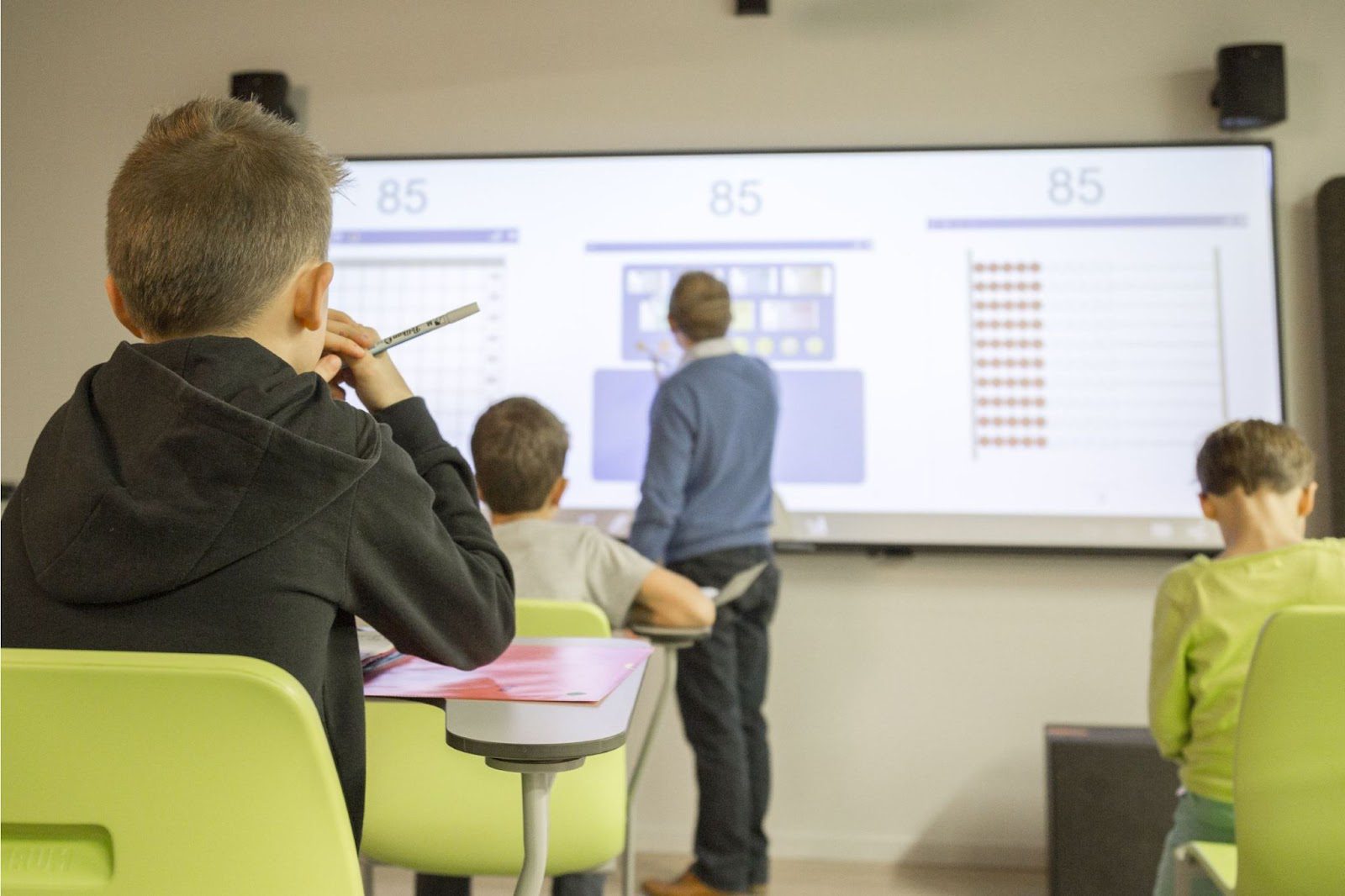
Educators were among the first to embrace this innovative technology. Interactive whiteboards proved invaluable for brainstorming, note-taking, games, and multimedia presentations. They transformed traditional classrooms into engaging, adaptable learning environments tailored to various learning styles. Teachers gained flexibility in lesson planning, while students benefited from visual aids like photos, diagrams, graphs, and videos.
Studies conducted after the boards’ introduction revealed improvements in students’ test scores, literacy rates, and attention spans, highlighting their positive impact on education.
Evolution of the Innovation
After the initial demonstration, SMART Technologies continuously released updated versions of the whiteboard. In 1992, the company launched a rear-projection model. In 1998, they introduced management software and SMART Notebook 2.0.
Interactive whiteboards evolved to include various screen types and resolutions. In 1999, plasma display boards were introduced, followed by flat-panel displays in 2003.
In 2005, SMART Technologies debuted a wireless tablet and tablet PC, allowing users to create and save digital ink notes on images, screenshots, or documents without altering the original content. All notes could be saved for future reference.
In 2007, the company launched the Senteo Interactive Response System, enabling teachers to track students’ progress and record assessment results in a built-in gradebook. New 2008 products included the SMART Document Camera and collaborative learning software, further enhancing the interactive learning experience.