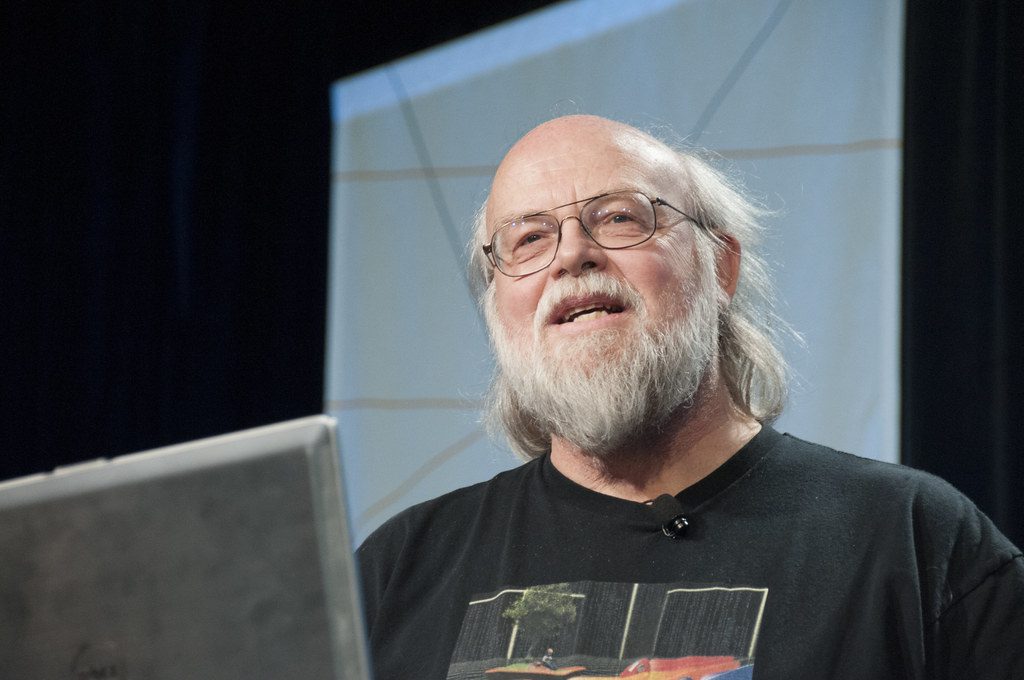

Java is an object-oriented programming language used for developing software, mobile applications, and more. It was invented by Calgary-born James Gosling. More details on icalgary.
Early Life and Education of Gosling
The Canadian computer scientist was born on May 19, 1955. As he noted in his blog, during his childhood, he loved playing games at his grandfather’s store and in the “bone yard”—a space near the shop where his grandfather parked old farming equipment.
Gosling attended William Aberhart High School in Calgary. After high school, he earned a Bachelor’s degree in Computer Science from the University of Calgary and a Master’s degree and PhD in Computer Science from Carnegie Mellon University in the United States.
While at the University of Calgary, he worked on a program that processed data from the Canadian ISIS 2 satellite. His colleagues frequently requested changes to the program. Inspired by the TECO text editor, which allowed users to write their own mini-programs, Gosling embedded a simple interpreter into the program he was working on, enabling users to make adjustments themselves.
One of Gosling’s notable early projects, before creating Java, was Gosling Emacs (Gosmacks).
How Was Java Created?
After completing his education, James began working at Sun Microsystems in the United States. During his time there, Gosling faced the challenge of translating program code from one language to another. He envisioned a language that could be written once and run anywhere. This idea led to the creation of the now-famous programming language in 1991.
Initially, Gosling named the language Oak because of an oak tree visible from his office window. It was originally intended for household electronic devices. However, due to copyright issues, the name was changed to Java after a colleague suggested it during a meeting. While developing Java, Gosling and his team emphasized its core principles: simplicity, reliability, object-orientation, security, multithreading, and more.
Java gained significant popularity when web browsers began incorporating Java applets for performing complex tasks. API development for desktop, mobile, and enterprise applications followed. The release of the Java Virtual Machine as free, open-source software further boosted its popularity and adoption in the software community.
Gosling worked on Java until 2010, when Sun Microsystems was acquired by Oracle Corporation. He left the company after 26 years, citing salary cuts, reduced decision-making power, and ethical concerns as reasons for his departure.
Gosling’s Career Post-Java

After leaving Sun Microsystems, Gosling advanced his career by joining Google in March 2011. Six months later, he moved to a startup called Liquid Robotics. In 2016, following Liquid Robotics’ acquisition by Boeing, Gosling joined Amazon Web Services as a distinguished engineer.
Awards and Recognition
In 2004, Gosling was inducted into the U.S. National Academy of Engineering for his conceptual and architectural contributions to Java and his work on the NeWS system.
He has been awarded the rank of Officer of Canada (the country’s second-highest civilian honor) and the IEEE John von Neumann Medal for outstanding achievements in computer science.
By creating one of the world’s most widely used programming languages, James Gosling revolutionized the field of programming. His contributions have had a profound impact on the world of technology and beyond.