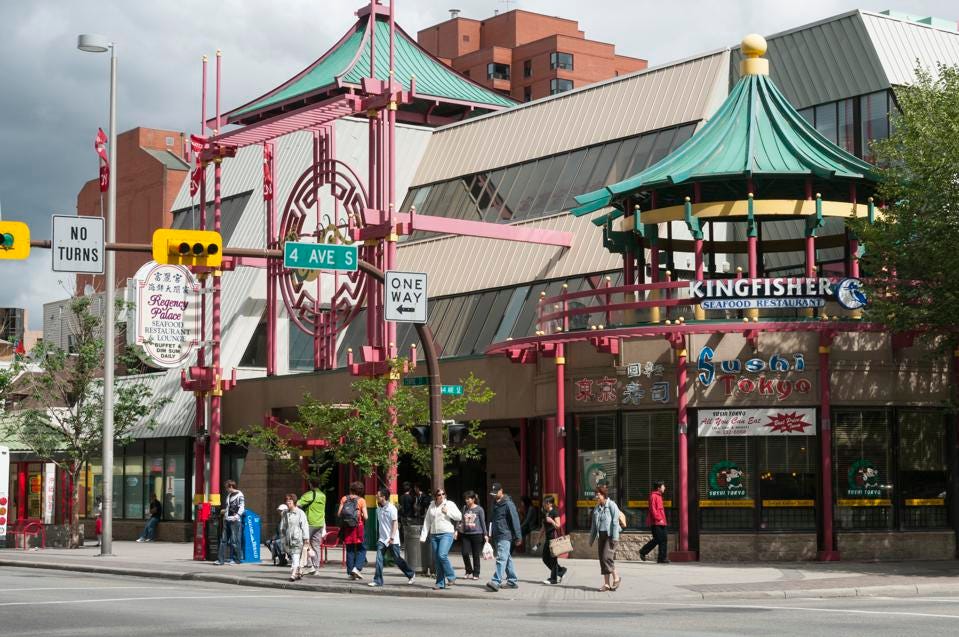

After the completion of the Canadian Pacific Railway (CPR) in 1885, British Columbia’s economy plunged into recession, leaving thousands of Chinese laborers impoverished and jobless. While some had savings to return to China, others settled in overcrowded Chinatowns in British Columbia. Many moved to Alberta in search of work, only to face racial discrimination. More on this below on icalgary.
Arrival in Calgary and the Establishment of Chinatown
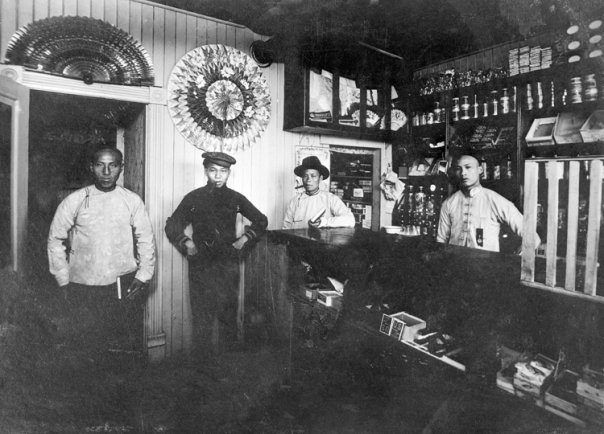
In Alberta, unemployed Chinese laborers primarily settled in Calgary and other railway towns. Many opened laundries since this business required minimal investment and no special skills.
Around 1890, the first Chinatown was established on the eastern outskirts of downtown Calgary. By 1900, it featured two restaurants, several laundries, two grocery stores, and a residential building. After 1901, the city’s Chinese population began to grow rapidly, leading to overcrowding and the need for relocation.
Notably, merchant Louie Keong became the first Chinese resident of Calgary to bring his wife to the quarter in 1905. Together, they welcomed the first Chinese-Canadian child born in Calgary.
The Second Chinatown
The Chinatown moved to the other side of the railway tracks, along 10 Avenue and 1 Street Southwest. It housed three restaurants, a tailor shop, the Chinese Mission, and several residential buildings.
Meanwhile, businesses in the old Chinatown continued to operate. For a time, Calgary had two small Chinatowns separated by the railway tracks. The second Chinatown lasted for ten years before another relocation became necessary.
In 1910, the Canadian Northern Railway (CNoR) announced plans to build a new route into the city and called for constructing a hotel near the second Chinatown. This led to skyrocketing property values in the area. Landowners evicted residents and sold their properties at high prices. The second Chinatown might have disappeared, but wealthy Chinese merchants intervened and purchased land for a third Chinatown.
The Third Chinatown
After lengthy negotiations, the third Chinatown was established post-1910 around Centre Street and 2 Avenue Southwest. By the 1920s, the area featured several associations, including the Chinese Public School, the Chinese Nationalist League, the Chinese Mission, and several clan organizations. New laundries and grocery stores frequently emerged in the neighborhood.
By 1921, Calgary’s Chinese population had grown to 688. However, in 1923, the Chinese Immigration Act, also known as the Chinese Exclusion Act, was passed by Canada’s Liberal Prime Minister William Lyon Mackenzie King’s government. This act barred most forms of Chinese immigration to Canada. Although immigration policies controlled various nationalities, only Chinese individuals were entirely prohibited from entering the country.
The Great Depression further hindered population growth. After the act’s repeal in 1947, the Chinese population began to grow again, reaching 973 by 1951 and 2,232 a decade later.
Chinatown in Jeopardy During the 1960s
In the 1950s, Calgary’s Chinese population continued to grow. However, by the 1960s, many preferred not to live in Chinatown. Years of neglect had left the neighborhood dilapidated and at risk of demolition.
In 1966, city planners proposed extending Bow Trail and building a new bridge on Centre Street, which would have led to Chinatown’s destruction. Determined to save their community, Chinese residents formed the Sien Lok Society of Calgary. In 1969, the society hosted a national conference to highlight urban development’s impact on Chinatown. This was the first conference of its kind in North America and drew media attention to the neighborhood’s plight. The efforts of Chinatown’s advocates led to its preservation as a cultural symbol and eventual revitalization.
Threats in the 1970s and 1980s
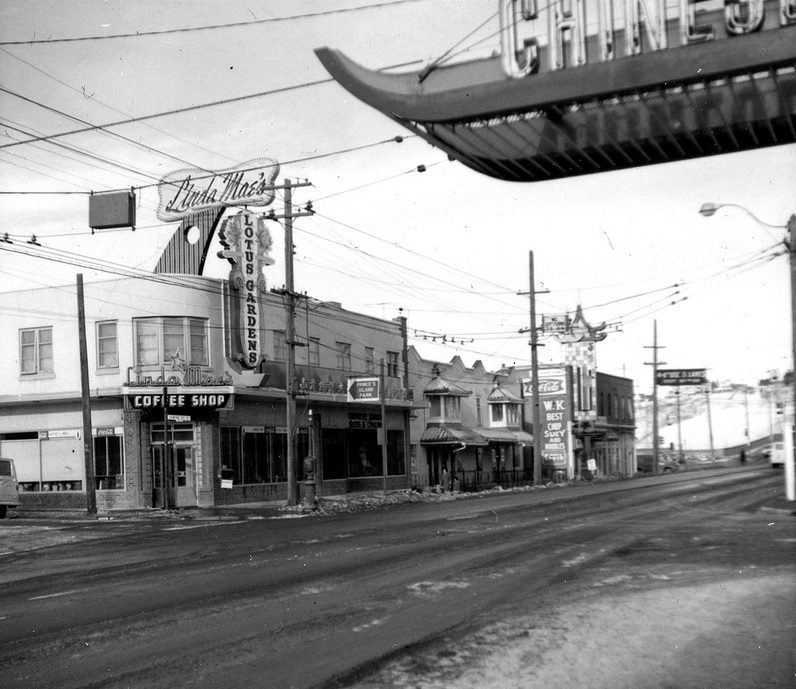
Although Chinatown’s fate seemed secure in 1969, new challenges arose in the following decades. In 1973, the construction of a federal government complex displaced 200 residents. Plans to expand Bow Trail resurfaced, but strong opposition from the Chinese community prevented it.
In the 1980s, developers targeted Chinatown due to its proximity to downtown Calgary. Their plans for dense redevelopment threatened the district’s unique character and atmosphere. The Chinese community rallied once more to save their neighborhood.
In 1983, the Chinatown Development Committee was established to mediate between the community and developers. A compromise was reached: developers received permission to build and rezone land, while the Chinese community was granted free property and funds to construct a long-awaited cultural center.
The Future of Chinatown
In 1910, the Calgary Herald described Chinatown as a “festering sore.” Since then, the neighborhood has flourished. By the early 21st century, it had become home to shopping centers, senior housing complexes, and numerous Chinese and international restaurants.
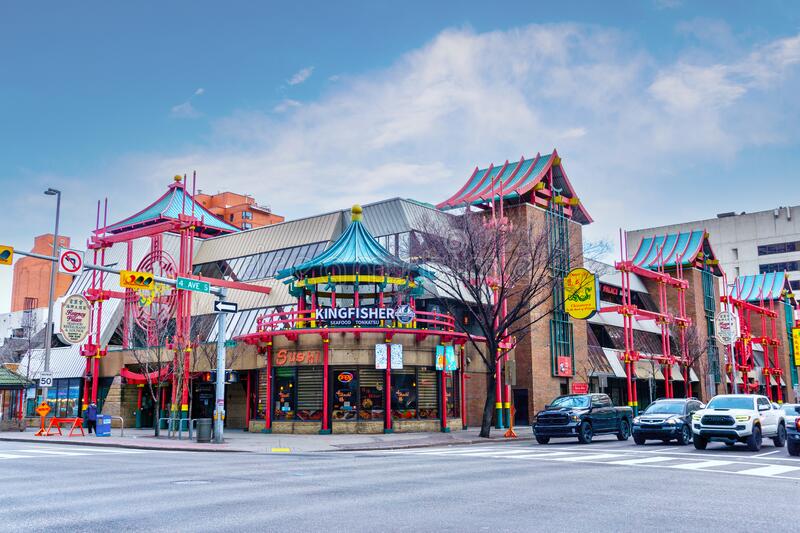
In 1992, the Chinese Cultural Centre was built, with its centerpiece being the Dr. Henry Fok Cultural Hall. Modeled after Beijing’s Temple of Heaven, the hall is supported by four gold-ornamented columns representing the seasons.
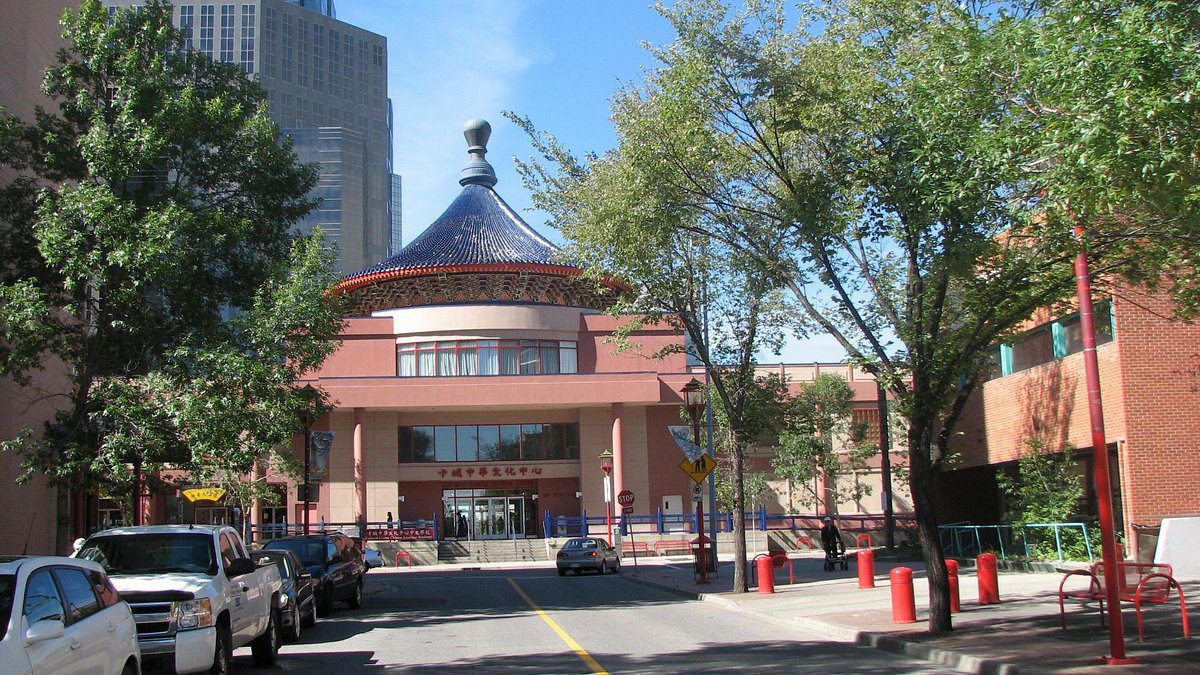
The center’s blue-tiled dome was crafted in China by the same company that created the Temple of Heaven. The building features classrooms, a library, a restaurant, and a museum of Chinese artifacts.
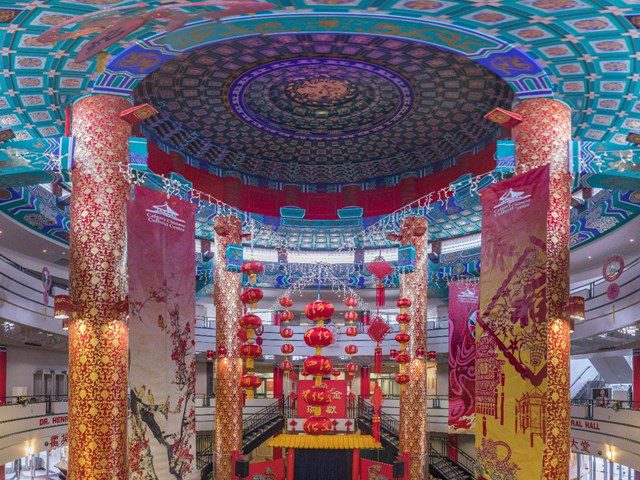
Dedicated to educational and cultural programs, the Chinese Cultural Centre enriches the lives of Calgary residents and visitors alike. As a landmark, it serves as a valuable historical resource, symbolizing the resilience and determination of Calgary’s Chinese community.
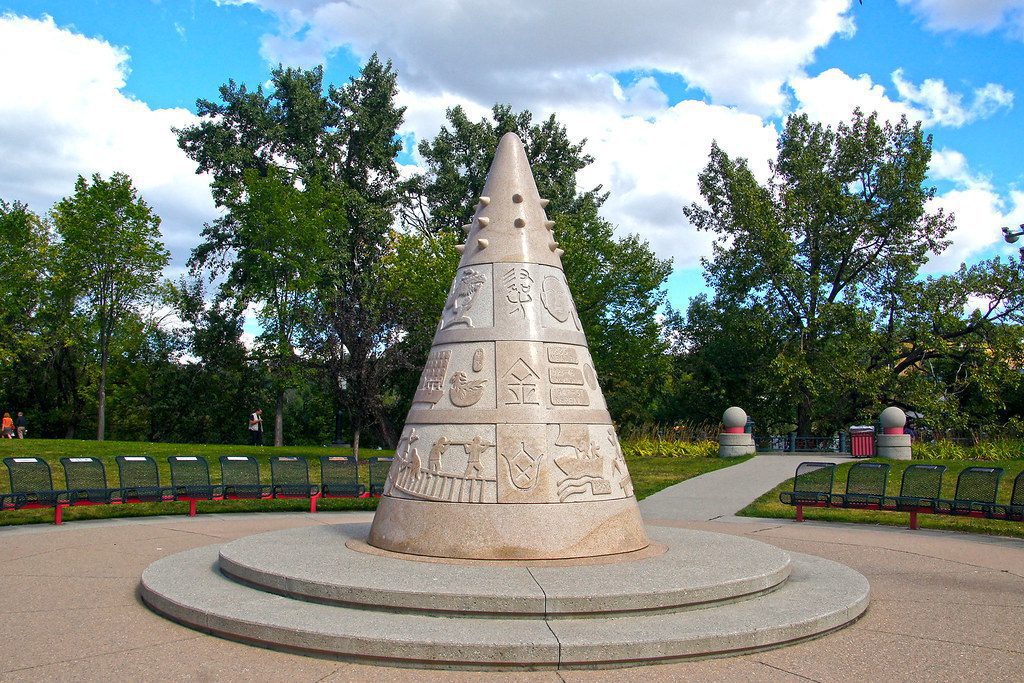
On the southern road of the Bow River lies the Sien Lok Chinese Cultural Park, opened in 1982. The park features the sculpture In Search of Gold Mountain by Chu Honsun, commemorating the Chinese experience in Canada.
As of February 2023, Calgary’s Chinatown is the fourth-largest in Canada. It remains a vibrant hub of Asian culture, language, education, community, and commerce.